
Description
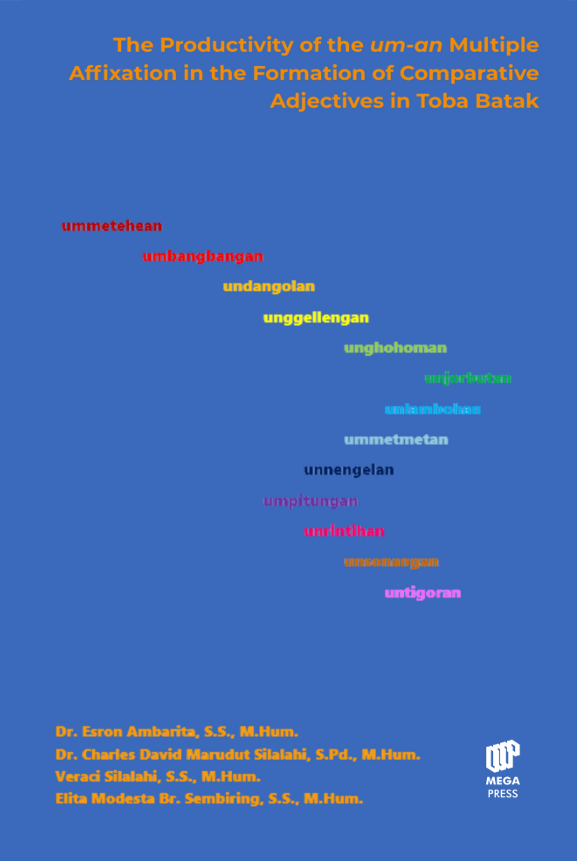
In Toba Batak comparative adjective formation, the realization of the multiple affixation um–an is systematically conditioned by the initial phoneme of the adjective base, reflecting the interaction between morphology and phonology, as follows:
1. Vowel-initial adjectives trigger gemination, causing um–an to surface as umm–an both orthographically and phonetically, e.g., ummiasan [ummiasan] ‘cleaner’.
2. Before the voiced bilabial plosive /b/, the orthographic form um–an is retained, but it is phonetically realized as [ub–an], e.g., umbutongan [ubbutoŋan] ‘fuller’
3. Before the voiced alveolar plosive /d/, um–an changes to un–an orthographically and is phonetically realized as [ud–an], e.g., undaoan [uddaoan] ‘farther’
4. Before the voiced velar plosive /g/, um–an changes to ung–an orthographically and is phonetically realized as [ug–an], e.g., unggemoran [uggemoran] ‘greedier’
5. Before the voiceless glottal fricative /h/, um–an changes to uk–an both orthographically and phonetically, e.g., ukhornopan [ukkornopan] ‘stingier’
6. Before the voiced palato-alveolar fricative /j/, um–an changes to un–an orthographically and is phonetically realized as [uj–an], e.g., unjonohan [ujjonohan] ‘nearer’
7. Before the alveolar lateral /l/, um–an changes to un–an orthographically and is phonetically realized as [ul–an], e.g., unlembaan [ullebbaan] ‘more careless’
8. Before the bilabial nasal /m/, um–an remains stable both orthographically and phonetically, e.g., ummuruhan [ummuruhan] ‘angrier’
9. Before the alveolar nasal /n/, um–an changes to un–an both orthographically and phonetically, e.g., unnengelan [unnεŋεlan] ‘more deaf’
10. Before the velar nasal /ŋ/, um–an changes to ung–an orthographically and is phonetically realized as [uŋ–an], e.g., ungngalian [uŋŋalian] ‘colder’
11. Before the voiceless bilabial plosive /p/, the orthographic form um–an is retained, but it is phonetically realized as [up–an], e.g., umpandean [uppaddean] ‘cleverer’
12. Before the alveolar trill /r/, um–an changes to un–an orthographically and is phonetically realized as [ur–an], e.g., unringkotan [urrikkotan] ‘more important’
13. Before the voiceless alveolar fricative /s/, um–an changes to un–an orthographically and is phonetically realized as [us–an], e.g., unsiahan [ussiahan] ‘spicier’
14. Before the voiceless alveolar plosive /t/, um–an changes to un–an orthographically and is phonetically realized as [ut–an], e.g., untigoran [uttigoran] ‘straighter’
15. The shift from /h/ to /k/ reflects regressive assimilation for articulatory ease, e.g., unghapalan [ukkapalan] ‘thicker’ from um–an + hapal ‘thick’.


Reviews
There are no reviews yet.